






Many assume that Google’s shift toward more user-centric, intent-based search began with the rise of AI tools like ChatGPT or Claude. But the journey started much earlier.
In 2013, Google introduced the Hummingbird update, marking a pivotal move from traditional keyword-based SEO to a semantic search approach. While Hummingbird wasn’t powered by large language models (LLMs), it laid the groundwork by prioritizing context y intent over exact keyword matches. It was one of the first steps toward incorporating Natural Language Processing (NLP) into search, setting the stage for today’s AI-powered, conversation-friendly search experiences.
We do not want to confuse you with all this SEO jargon, so let us get on to the point.
What Are LLMs and Why Do they Matter to SEO
Large language models (LLMs) are foundational models trained on vast amounts of data, enabling them to understand and generate natural language and other types of content, thereby performing a wide range of tasks.
Is that difficult to understand? Let us explain, imagine it’s the era before LLMs — you type ‘My food is bad’ into a food delivery app’s chatbot, and it gives you irrelevant options; but with an LLM, the bot understands exactly what you mean and offers a refund or replacement instantly — just like a human would. That is the power of LLMs.
In the past, SEO was all about keyword stuffing — loading content with exact-match phrases in the hope of ranking higher on search engines. But that approach rarely served the reader. It was more about satisfying the algorithm than solving a user’s actual problem.
That’s changed.
Today, Google focuses on why a user searches — the intent behind the query — rather than just matching exact words. Search engine results are now influenced by semantic understanding and contextual relevance. In other words, your content must address real user needs, not just sound impressive or technical.
With AI-driven features like Search Generative Experience (SGE), Google now summarizes answers based on what users truly want to know. If your content doesn’t clearly answer those questions — and instead tries to sound overly intellectual or vague — it likely won’t be surfaced in these AI-generated overviews.
Modern SEO is no longer about gaming the system. It’s about understanding your audience, structuring content clearly, and delivering value that aligns with how AI understands language and intent.
How LLMs Interpret and Rank Content Differently
Take ChatGPT, for example—one of the most widely used large language models today. People ask it everything—from technical problems to something as simple as “How to cut an apple.”
In the past, a user might have typed that query into Google, clicked through blog posts, or watched a YouTube tutorial. But search behavior has evolved. Now, many users turn to ChatGPT or other AI tools for direct, instant answers—no extra clicks, no distractions.
With Google’s AI Overviews, the shift is even more pronounced. Users are presented with summarized, AI-generated answers right at the top of search results. They often don’t scroll further or click through to actual websites.
The impact? Many websites have reported traffic drops of over 40% since the rollout of AI Overviews, because users never make it past the summary box. Traditional SEO strategies are no longer enough. Content now needs to adapt to an AI-first search landscape. Large Language Models (LLMs) like ChatGPT and Google’s Gemini don’t rely solely on keyword matching. Instead, they interpret natural language, understand contextual relevance, and prefer conversation-like structures. They’re trained to surface content that mimics how people speak and seek information, not just what they type. So if you’re still writing for algorithms from 2010, it’s time to shift. In the world of LLMs, it’s not just about ranking for a term—it’s about answering a question, clearly and conversationally. Large Language Models(LLMs) don’t just scan for keywords — they understand entities and how these entities relate to one another across the web. When someone asks a question, the LLM doesn’t match phrases. It’s drawing connections between concepts, people, products, and industries — all mapped within a broader knowledge graph. This is why entity-based content performs better. It’s not because it checks an SEO box, but because LLMs are trained to understand relationships between ideas, not just the words used to describe them. And this is where topic clusters play a key role.
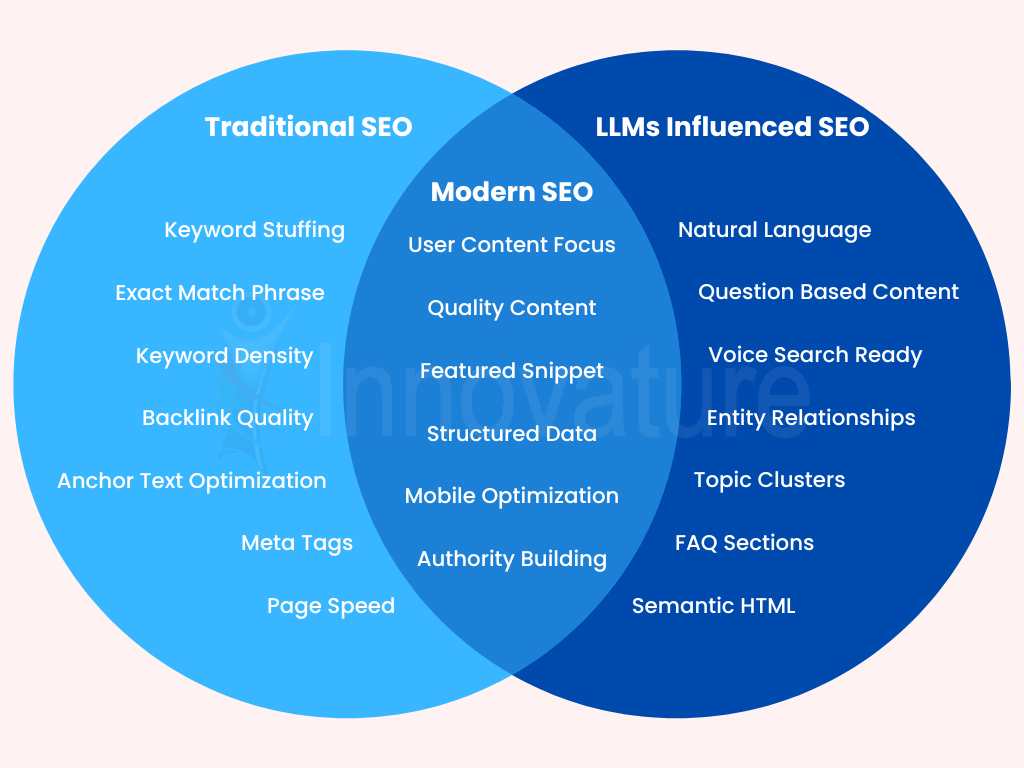
When your content is structured into clusters — with one central idea and multiple supporting pieces around it — you’re not just making it easier for Google. You’re helping LLMs see depth, understand hierarchy, and recognize authority. LLMs prefer content that mirrors how humans learn: by connecting ideas, not isolating them.
Featured Snippets, AI Overviews & Voice Search: What You Need to Optimize For Now
Google’s search results now feature multiple AI-powered formats that are reshaping how users find information:
Featured Snippets continue to provide direct answers by pulling highlighted content from specific web pages, while AI Overviews represent Google’s newer approach—delivering AI-generated summaries that synthesize information from multiple sources directly at the top of search results. Meanwhile, voice search through AI assistants reads these answers aloud to users.
This shift is significant because users no longer need to click through multiple sites—they get comprehensive answers instantly. But here’s the key: none of these features pulls content randomly. They all look for content that is easy to understand, well-organized, and genuinely user-centric.
Elements like clear headers, bullet points, FAQs, and concise definitions are prime candidates for all three formats. If your content is buried under jargon or overly complex sentences, it’s unlikely to be featured in Featured Snippets, AI Overviews, or voice responses.
The rise of these AI-powered search features means your content must be prepared to be “read aloud” by AI systems and featured in these prominent spots. This represents a huge opportunity, but it requires a different approach to content creation—one that favors clarity, structure, and direct answers over lengthy, keyword-stuffed pages.
How to Write for AI-Driven Search
Optimizing content for AI-powered search results, such as SGE and Featured Snippets, requires intentional writing and strategic formatting. Here are actionable tips to help your content get picked up and highlighted by these systems:
- Use conversational phrasing: Write the way people talk. Instead of “Utilize our software for optimization,” say “Use our software to improve your results.” This helps LLMs understand and pull your content naturally.
- Answer specific questions clearly and succinctly: AI loves short, precise answers. When you target FAQs or common queries, aim for 2-3 sentences that directly address the question without fluff.
- Structure content with semantic HTML: Proper use of headings (<h2>, <h3>), paragraphs (<p>), and lists (<ul>, <ol>) helps AI bots parse your page quickly and correctly. This structural clarity improves your chances of being featured.
- Add FAQ sections: FAQs are a goldmine for featured snippets and voice assistants. They clearly highlight questions and answers, making it easy for AI to extract and display.
- Build topic clusters: Organize your content into a main pillar page supported by related subtopics. This helps LLMs see the depth and hierarchy in your content, signaling authority and comprehensive coverage of the subject.
To Conclude: Writing for People And AI
The fundamental shift in search means SEO is no longer about tricking algorithms with keywords and backlinks. Instead, it’s about crafting meaningful content that genuinely helps users and is easily understood by AI.
Think of it this way: Large Language Models aren’t just scanning words; they’re mapping concepts, understanding relationships between entities, and learning from context. When your content mirrors how humans naturally learn — by connecting ideas and providing clear, concise information — LLMs are more likely to trust and recommend it.
By focusing on entities, creating topic clusters, and adopting AI-friendly writing and formatting techniques, you build a content ecosystem that serves both your audience and the new AI-powered search engines. This approach not only improves your visibility but also future-proofs your SEO strategy in an AI-first world.