





Introduction
Cost is always top of mind: Are we investing wisely? Is this partner right? Will AI actually deliver? A big worry is that cheaper solutions might mean cutting quality. Here’s the truth: AI doesn’t reduce quality—it reduces wasted effort. By automating repetitive tasks and speeding up development, AI lets businesses see results in an accelerated timeline. Early adopters have seen massive returns—because the upfront investment leads to smarter, not lower, outcomes. Cheaper, in this case, means more efficient, not less capable.
When you look at cost versus ROI, early adopters of AI solutions often see a tenfold return and almost 20% to 30% faster workflow.
Source: How Agentic AI is Transforming Enterprise Platforms, BCG 2025
Automation, predictive models, agentic AI—they all deliver. But here’s the catch: those returns need upfront investment—resources, infrastructure, talent. So the real question is: Are businesses ready to commit to that for long-term gain?
And not ‘Cheaper Solutions Mean Compromising Quality.’
Traditional Delivery Model
How were things in the pre-AI era? A quick walk down memory lane tells us that organizations looking for custom solutions usually begin with extensive requirement gathering. This was followed by large development efforts, multiple stages of testing, deployment, and months of maintenance, along with infrastructure planning depending on the scale and growth of the project.
The model itself wasn’t flawed. In fact, it worked well for years. The real issue was how resource-intensive it became. When something broke, someone had to be there to fix it. When something changed, another resource had to step in and work on it until the issue was resolved.
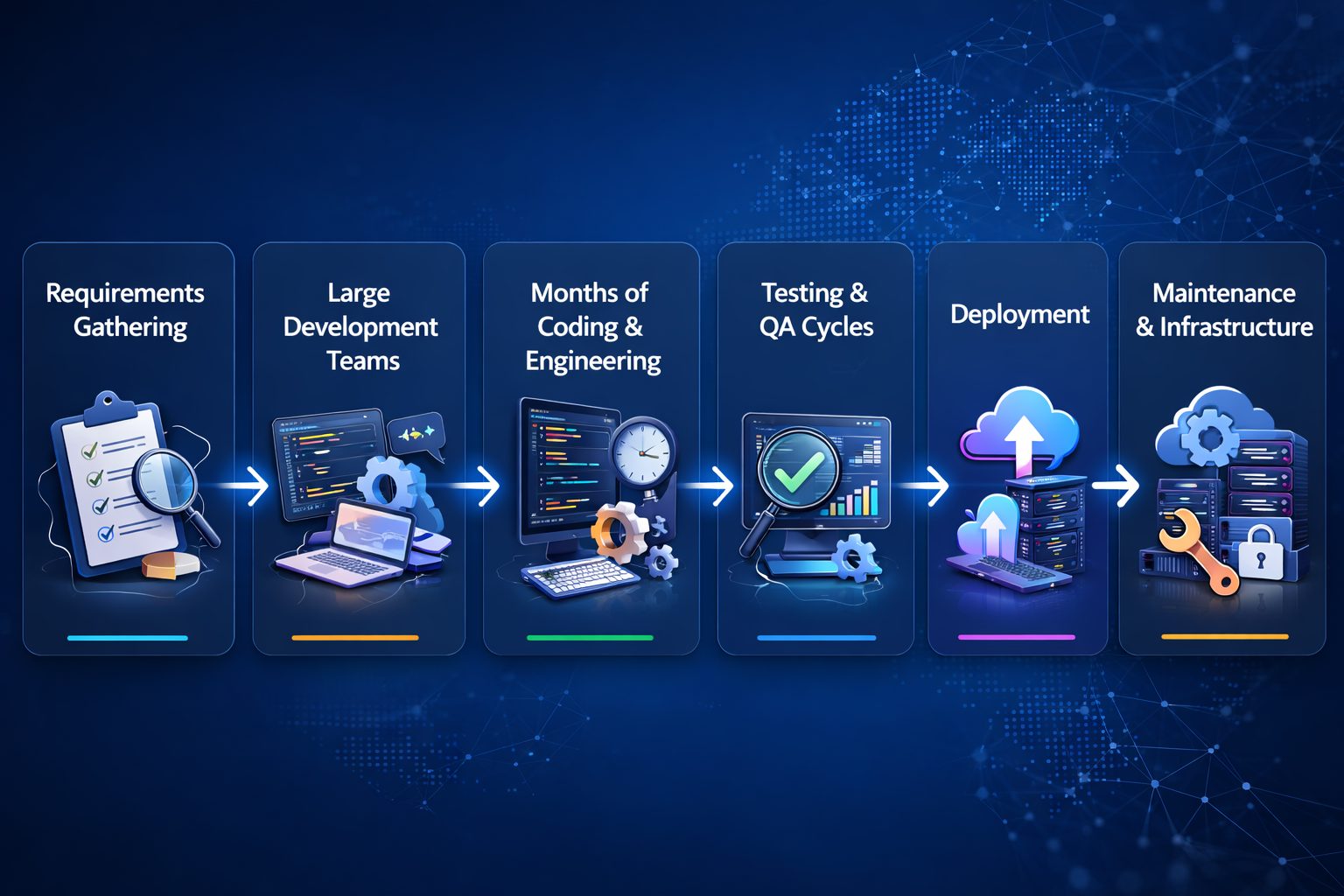
Large teams, long development timelines, and continuous support requirements meant the model was heavily driven by time and materials. Naturally, this pushed costs upward. As a result, businesses often spend significant budgets on technology implementations long before they can see any real operational impact.
In many cases, the cost wasn’t driven by complexity alone. A large part of it came from the manual effort required to build, manage, and maintain these systems.
How AI Changes the Landscape
So what changed with the arrival of AI?
AI-native development approaches technology a little differently. Instead of building every component from scratch and spending time constructing the underlying systems, modern AI solutions make use of pre-trained models, intelligent automation, and reusable frameworks that significantly reduce manual engineering effort. This means that more code is being shipped in lesser time, tasks that typically required 2 months to complete before are getting done in a span of weeks now.
This shift allows organizations to focus more on solving the actual business problem rather than spending most of their time building the plumbing underneath it. When automation is combined with domain expertise, solutions that once took months to build can now often be deployed in a matter of weeks.
A good example of this change can be seen in the tools developers now use every day. Coding assistants such as Cursor AI, Claude Code, and similar AI-powered developer tools built on top of modern IDEs help engineers write, review, and ship code much faster than before. Tasks that once required hours of manual coding, debugging, or documentation can now be accelerated with AI-assisted workflows.
The important thing to understand here is that this shift does not reduce quality. What it actually reduces is inefficiency.
Lower costs in AI-driven solutions are usually the result of improved operational efficiency rather than reduced capability. In many cases, organizations are simply able to do more with fewer manual steps involved in the process.
Three factors make this possible.
- Automation of Repetitive Tasks: AI systems can automate many tasks that previously required significant manual (human) effort from development and operations teams. Activities such as data processing, workflow management, and decision support can now be handled through intelligent systems. This reduces labor-intensive work while still maintaining accuracy and consistency. This allows teams to focus on the more complex tasks that need actual human intervention.
- Faster Implementation Cycles: AI-enabled platforms allow companies to implement solutions far more quickly than traditional development models. When systems can be deployed in weeks rather than months, development overhead naturally decreases. Organizations also begin seeing business value much earlier in the lifecycle of the project. This makes trust come easy between the solution provider and the seeker of the solution; the latter, in this case, would have more clarity and less doubt on the ability of the solution.
- Scalable Systems: Unlike traditional rule-based software, AI systems can continuously learn and adapt. As they process more data and user feedback, they improve their outputs and understanding of patterns. This allows solutions to scale both horizontally and vertically as the organization grows. In simple terms, the system doesn’t remain static — it evolves along with the business. This is where the idea of AI as a service starts to become important. Instead of every organization building complex AI capabilities internally, companies can partner with technology providers who act as the engine that enables faster AI implementation. In that context, lower cost is not a compromise; more tasks are getting done in less time without affecting the quality and the efficiency of the product.
The Numbers of Success: How we scaled the Impact
By prioritizing community-led growth and solving the “Identity Loop” through technical innovation, our partner didn’t just gain customers—they gained a loyal community. The transformation was measurable:
- 90% Reduction in Onboarding Time: The journey from “Invisible” to “Connected” was reduced from days to minutes. This meant that the earlier onboarding time was significantly lower, which resulted in getting more people drawn to the idea of a product, which was a necessity and could be onboarded in less time than before.
- 60% Gain in Operational Efficiency: The automated Admin and Agent hierarchy allowed the brand to scale its user base massively without a proportional increase in staff or overhead.
- 100% Digital Onboarding Path: We successfully removed every piece of paper from the process, making it the most accessible MVNO solution in the country.
How are Organizations Putting this into Practice
For many companies, the shift toward AI-native development is still a work in progress. It requires changes not only in technology but also in how teams work, how projects are delivered, and how developers interact with modern tools.
At Innovature, this shift has been deliberate.
One of the first steps was introducing AI-assisted development tools across engineering teams. Tools such as Cursor AI and similar AI-powered coding assistants have been implemented organization-wide to help developers write, review, and ship code faster. Instead of spending long hours on repetitive coding tasks, developers are now able to focus more on solving the actual business problem while AI assists with the underlying implementation.
In practice, this means engineers are trained to combine their domain knowledge with AI-assisted development workflows. The emphasis shifts from writing every line of code manually to designing systems, orchestrating AI tools, and delivering solutions more efficiently.
Leadership across the organization has also played an important role in this transformation. There has been a conscious push to ensure that new projects explore opportunities where AI can create a measurable impact — whether through automation, faster delivery cycles, or smarter decision-making capabilities within the solution itself.
The goal is simple: To ensure that AI is not treated as a buzzword but as a practical tool that improves how technology solutions are designed, built, and delivered.
In that sense, the shift toward AI-native development is not just about faster coding or lower costs. It is about rethinking how modern technology solutions are built, where efficiency, automation, and intelligent systems work together to deliver better outcomes for businesses.