





Introduction
Détail breaks the moment when your inventory starts to lag. Not because demand is unpredictable—but because the data describing it is late, fragmented, and inconsistent. When stock positions are updated in batches across multiple ERPs and warehouses, every downstream decision—forecasting, replenishment, allocation—starts from a stale baseline.
This is the real playground for streaming data.
The Problem
A large UK outdoor apparel retailer faced a critical issue: key decisions were being made on outdated inventory data, driven by batch-based systems and delayed synchronization across backend platforms.
In a large, multi-channel retail setup, inventory is constantly moving—sales, returns, transfers, inbound shipments. But if systems reconcile these movements only in periodic batches:
- E-commerce shows items that are already sold out in stores
- Stores operate without visibility into warehouse stock
- Replenishment engines overcompensate with higher safety stock
- Teams rely on manual fixes during peak periods
The result is predictable: latency between systems slows decision-making, leading to stockouts where demand is high, excess inventory where it isn’t, and slower responses when speed matters most.
Batch Updates to Continuous Inventory Flow
The ‘Wow Factor’ was what made the inventory a live stream of events.
Every stock movement—sale, return, transfer—is captured and propagated in near real time across systems.
This was enabled by:
- Event-driven pipelines (streaming platforms, message queues)
- Change Data Capture (CDC) from ERP systems
- A canonical inventory model that standardizes SKUs and locations
- Low-latency data layers for fast reads across channels
Our outcome was a single operational view of inventory that updates continuously and is accessible to e-commerce, stores, and replenishment systems.
How Does This Inventory Flow Lead to Replenishment
The logic of Replenishment depends on three things: current stock, demand signals, and lead times. When inventory data is delayed, systems compensate with buffers—usually in the form of inflated safety stock.
With Streaming Data:
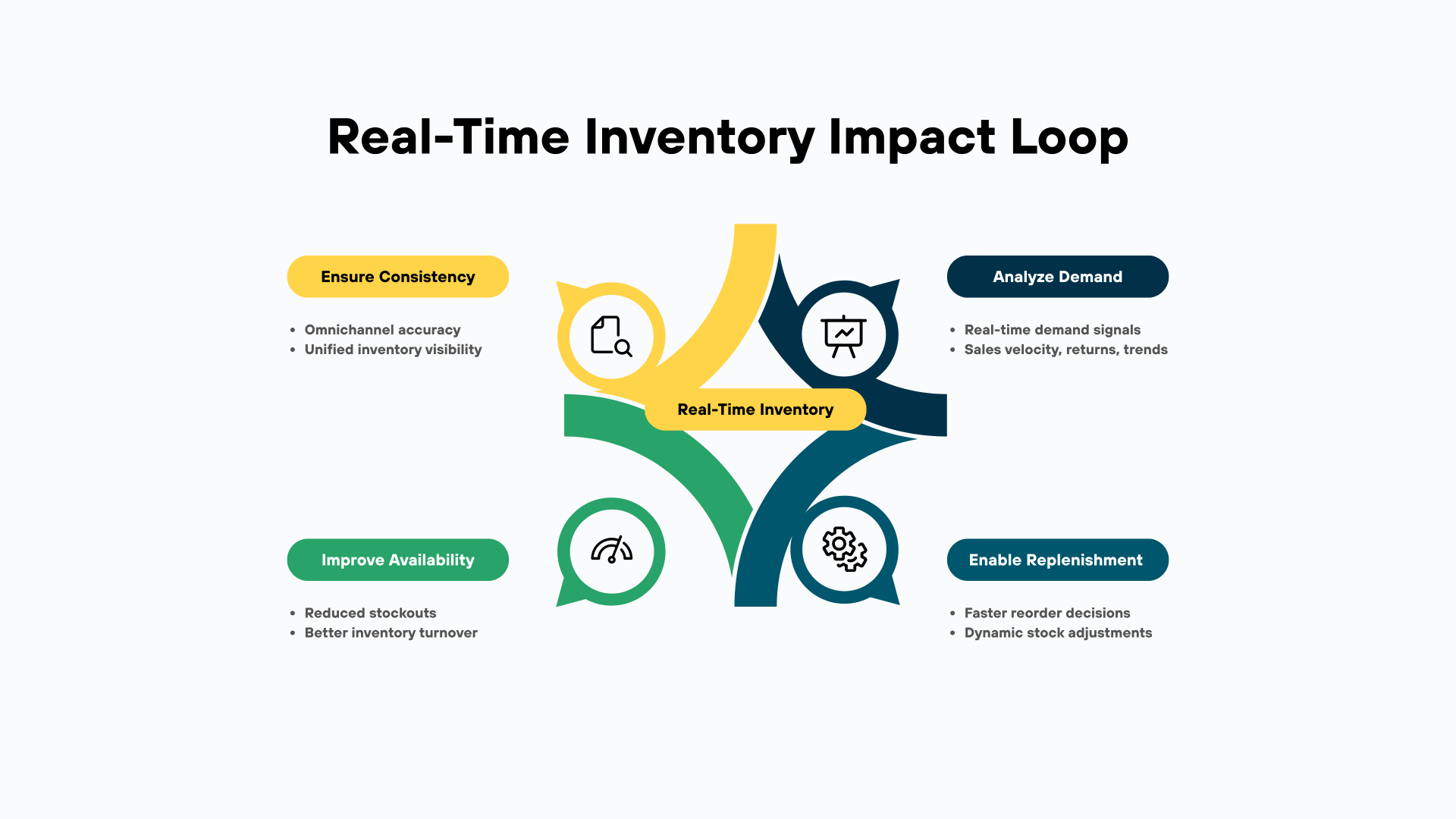
- Stock positions are accurate to the minute
- Demand signals (sales velocity, returns) are updated continuously
- Forecasts adjust faster to real-world changes (weather, promotions, local spikes)
What Changes in Practice
-
- Lower safety stock without increasing risk: With streaming data, retailers can reduce risk by no longer having to guess stock levels and replenishment timing, freeing up less capital tied up in inventory.
- Faster, more accurate reorder decisions: Instead of periodic replenishment runs, systems can trigger decisions continuously or at shorter intervals. This automatically adjusts reorder points, resulting in purchase orders and transfers that reflect demand.
- Inventory Turnover: When stock is more closely aligned with demand, slower-moving inventory is identified more quickly, and fast-moving SKUs are replenished faster. This improves sell-through rates and overall turnover.
- Smarter ML-driven forecasting: The veracity of ML models depends heavily on data freshness, as models learn from near real-time demand patterns and forecast errors reduce during volatile periods.
Omnichannel Impact: Connecting Inventory to Customer Experience
Replenishment doesn’t operate in isolation—it directly shapes how inventory behaves across channels. With a unified, near real-time view of stock, ecommerce platforms reflect actual product availability, reducing instances where customers order items that are no longer in stock.
In stores, teams gain visibility into warehouse and cross-location inventory, enabling better assistance to customers and fewer missed sales opportunities. For order fulfillment, accurate and current inventory data ensures that orders are routed correctly—whether it’s ship-from-store, warehouse dispatch, or click-and-collect—minimizing delays and cancellations.
Closing Note
Smarter replenishment is ultimately a data problem before it becomes a forecasting or operational one. When inventory data moves from delayed, batch updates to continuous streams, every dependent system—forecasting, allocation, fulfillment—becomes more responsive and reliable.
The result is not just improved efficiency, but a more consistent and dependable retail experience—where decisions are made on what is happening now, not what happened yesterday.