





Introduction
A historical look at logistics data shows that the global logistics industry has operated on razor-thin margins, where the difference between losses and profitability has been measured in minutes, delivery times, and cents per pound of freight. This, coupled with regulations and evolving tech, has put SMEs based out of Montreal and Quebec in a fix, because for these businesses, the selection of Customer Relationship Management (CRM), Marketing Automation, and Enterprise Resource Planning (ERP) is no longer a localized IT decision but a core strategic pillar that dictates a firm’s long-term financial health. As logistics providers in Quebec seek to modernize, they increasingly encounter the “Total Cost of Ownership” (TCO) paradox: platforms that appear “free” or “low-cost” at entry often evolve into multi-layered financial traps as the organization scales.
In this long-form analysis, we provide a comprehensive evaluation of HubSpot’s pricing architecture, contrasting its fragmented cost model with a unified alternative like Zoho to demonstrate how a 37% TCO reduction is systematically achievable.
The Macro Economic Landscape of Canadian Logistics Hubs
Montreal has long been a pivotal hub for North American logistics, serving as a gateway for international trade via the Port of Montreal and as a central node for trucking and rail networks connecting the Northeastern United States with the Canadian interior.
The historical trend for these SMEs was to adopt a “best-of-breed” approach, selecting a standalone CRM for sales, a separate tool for email marketing, a third for accounting, and a fourth for transportation management. However, this fragmented architecture has reached a breaking point. The emergence of “integration fatigue”—the operational drag caused by managing multiple disconnected data silos and uncontrolled app sprawl—is now identified as a primary threat to productivity and growth.
[Source: smetoday.co.uk]
Deconstructing the TCO Mechanics of Legacy Systems
To understand how this 37% TCO reduction is possible, one must first deconstruct/understand the ‘Sticker price’ of dominant market players like HubSpot and Salesforce. The initial attraction for these mid-market players includes reputation, ease-of-use, and rapid ‘time-to-value’. HubSpot, in particular, has built its brand on the promise of “inbound marketing,” providing a free CRM that serves as a high-conversion entry point for growing teams. The catch is when the scaling of the team happens. Here, the pricing changes from being linear to exponential.
The Mechanism of Pricing Jumps and Feature Gating
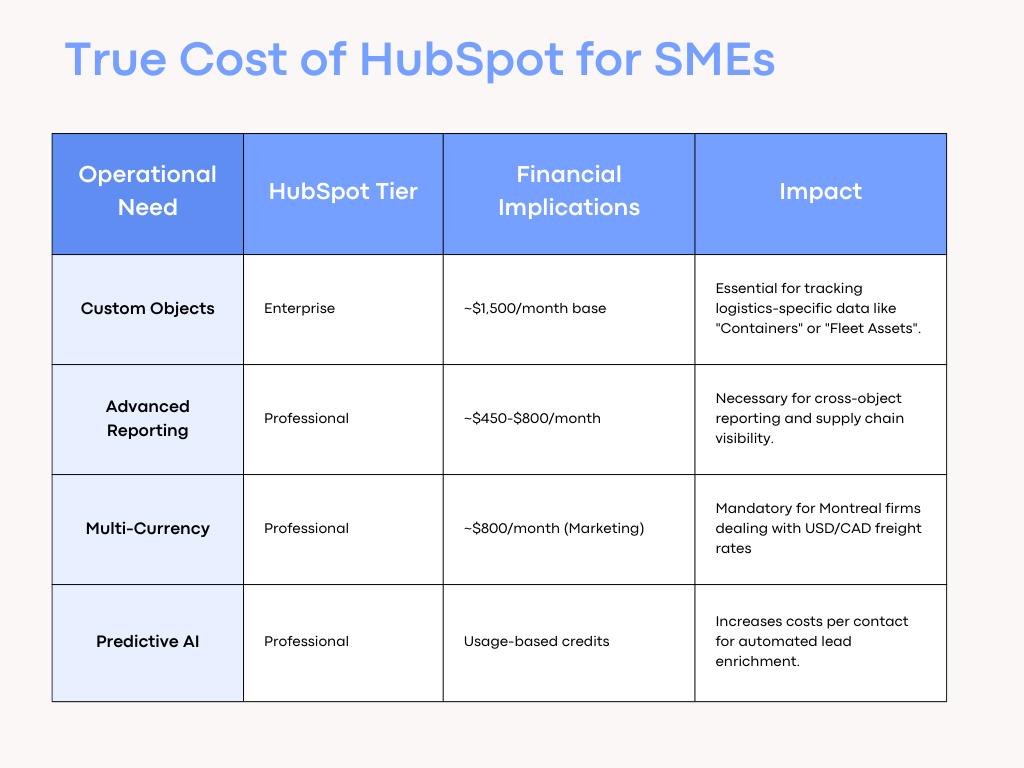
In a typical mid-market logistics firm, growth necessitates advanced features: custom objects to track shipments, predictive lead scoring to identify high-value carriers, and multi-currency support for cross-border operations. In legacy ecosystems, these essential business functions are frequently “gated” behind premium tiers. For example, while HubSpot’s Starter plans may begin at a nominal monthly fee, the transition to the Professional or Enterprise tiers involves a financial cliff that can surprise unprepared management teams.
[Source: loveable]
Take a look at the data below for comparison.
Usage-Based “Bait-and-Switch” and AI Credit Inflation
In the quest to monetize AI, legacy platforms have introduced “credit” systems that can lead to catastrophic billing surprises.HubSpot’s recent introduction of “Smart Fields” and its transition to a unified “HubSpot Credits” system (formerly Breeze Credits) exemplifies this risk. Each request to an AI-powered field costs approximately 10 credits, which translates to roughly 10 cents per contact. While this unit cost appears minor, logistics firms often manage databases with tens of thousands of carriers and prospects. This itself can translate into a substantial billing/month.
This is a huge implication for the logistics sector, as the data here is highly dynamic and details such as Contact lists, shipping histories, and carrier preferences are constantly updated. A system that charges “per request” for data enrichment creates a variable expense that is impossible to budget for with certainty.
The Compliance Tax
Fragmented stacks (using 5+ disconnected tools) create a massive administrative burden because Quebec law now requires:
- Privacy Impact Assessments (PIAs): These are mandatory when acquiring or overhauling any digital system that handles personal information. If an SME has 10 different tools, they technically face 10 times the compliance work.
- Data Portability: As of September 2024, businesses must be able to export data in a “structured, commonly used format”. This is much harder to execute across a “Frankenstack” or a disjointed stack, rather than in a unified system like Zoho.
The Hidden Cost of “Integration Fatigue”
In logistics, data is a lifeline; it is the centrepiece that holds everything together. However, when the data is spread across multiple tools, it creates operational nightmares.
[Source: rwave.eu]
For a Montreal-based 3PL or freight forwarder, this fatigue manifests as employees manually copying alerts or shipment data between a CRM and a separate Warehouse Management System (WMS) because the “brittle” integration broke. Furthermore, legacy hubs often use API limits as a leverage point; exceeding these daily limits can suspend your integrations entirely, leaving your dispatchers looking at “stale” data for up to 24 hours until the limit resets.
The Trap of Consultancy and the Mandatory Hourly Retainer Fees
A significant portion of the “Total Cost” in TCO comes after the contract is signed. Legacy platforms are often “designed for developers” rather than end-users, requiring specialized consultants to handle even basic customizations.
- Implementation Premiums: HubSpot requires mandatory onboarding fees ranging from $3,000 to $7,000.
- Consultant Dependency: Local specialized consultants typically charge between $150 and $300 per hour.
- The Workflow Gap: While a unified system allows you to build workflows in minutes, legacy systems often require complex scripting or third-party middleware like Zapier, adding yet another subscription to your monthly bill.
The Data Edge for Canadian Businesses
For Quebec businesses, the choice of a unified system isn’t just about saving money—it’s about local relevance. Zoho has invested heavily in the Canadian market with dedicated data centers in Montreal and Toronto. This is a critical advantage for Law 25 compliance, ensuring that sensitive logistics and customer data remain on Canadian soil.
Furthermore, for a Montreal SME, the administrative burden of dual-taxation is a constant friction point. Zoho Books is uniquely adapted for the Quebec market, offering native support for GST and QST dual-taxation and automated bilingual invoicing (French and English) out of the box.
Conclusion
By eliminating the “Success Tax” on contact growth, removing the need for expensive middleware, and consolidating Law 25 compliance into a single system, the 37% reduction isn’t just possible—it is the floor.
For Montreal logistics providers, partnering with a regional expert like Innovature—whose delivery model is specifically engineered to unify dispatch and finance while handling local requirements like GST/QST and CUSMA documentation—is the strategic move that turns technology from a variable expense into a permanent competitive advantage.