





Introduction
Imagine running a large hospital network with multiple facilities, clinics, and research centers. Patient data is fragmented across various electronic health records (EHR) systems, medical devices, lab results, and even medical images (X-rays, MRIs). For a small clinic, a basic record system may suffice, but for a large network, they need to analyze population health trends, predict disease outbreaks, optimize resource allocation (like bed and staff availability), and personalize treatment plans. Getting a single, trusted view of a patient’s health history—or the entire population’s—is impossible when the data is scattered and disconnected.
What is the Challenge?
Modern enterprises are flooded with data from a multitude of sources: spreadsheets, social media, IoT devices, and millions of transactions. They invest heavily to manage it all, yet the larger the organization, the harder it becomes to turn that data into real business value. Too often, instead of extracting insights from what they already have, companies burn resources jumping from one platform to another in search of a magic fix.
The challenge is threefold: complexity, lack of trust, and the lack of proper understanding of data critical to business or master data. The current landscape requires organizations to treat data as a new player, including not just text and numbers, but also audio, video, and images. What holds most organizations back is that this diverse, multi-modal data is scattered across different, siloed systems, which makes it hard to trust. This, coupled with decision makers unable to make out what data to actually trust to bring in value for their organization, poses a serious problem in how data is used or processed. Meaning that if people do not know how to make proper use of the data they have access to, then the whole purpose of this becomes futile.
But what if every person on your team—not just your data scientists or data engineers—could easily access and understand your data, with a little help from AI and the right platform? That’s the promise of democratizing data and AI. By unifying all of their structured and unstructured data, businesses can adopt AI in the right way, making them multi-cloud ready and simplifying their entire data architecture.
Why is embracing this Organization-Wide Difficult?
Even with all the hype around data and AI, most companies still struggle to leap from guessing to knowing.
Lack of In-house Experts
Hiring a team of data scientists and AI specialists is expensive, and it’s simply not an option for many startups and growing companies, because they simply cannot afford it. A significant no of companies, especially small-scale organizations, simply lack the dedicated staff to manage data and AI projects. As per research done by EY on AI adoption in European Financial Services, it is noted that out of the surveyed people, 29% feel that they lag behind their peers in terms of AI adoption, and only 9% believe that they are ahead of their peers.
The factors hindering this include workforce inexperience, regulatory uncertainty, and the rapid evolution of data and AI technology.
[Source: AI Adoption in the European Financial Services, EY, Dec 2024]
This is where a partner like Innovature can step in to help you bridge that gap. We can help you with the necessary technical expertise required to enable and embrace this paradigm shift across your organization.
Your Systems can’t keep up
Older data systems weren’t built for the sheer volume and variety of today’s data; they served the data requirements of a time before. Trying to manage everything from spreadsheets to video streams often requires complex, costly infrastructure that’s out of reach for smaller businesses.
Data is Distributed
Data is often scattered across different platforms, making it impossible to get a complete view. As per research conducted by Mattilion, the mean number of data sources per organization is 400. More than 20 percent of companies surveyed were drawing from 1,000 or more data sources to feed BI and analytics systems.
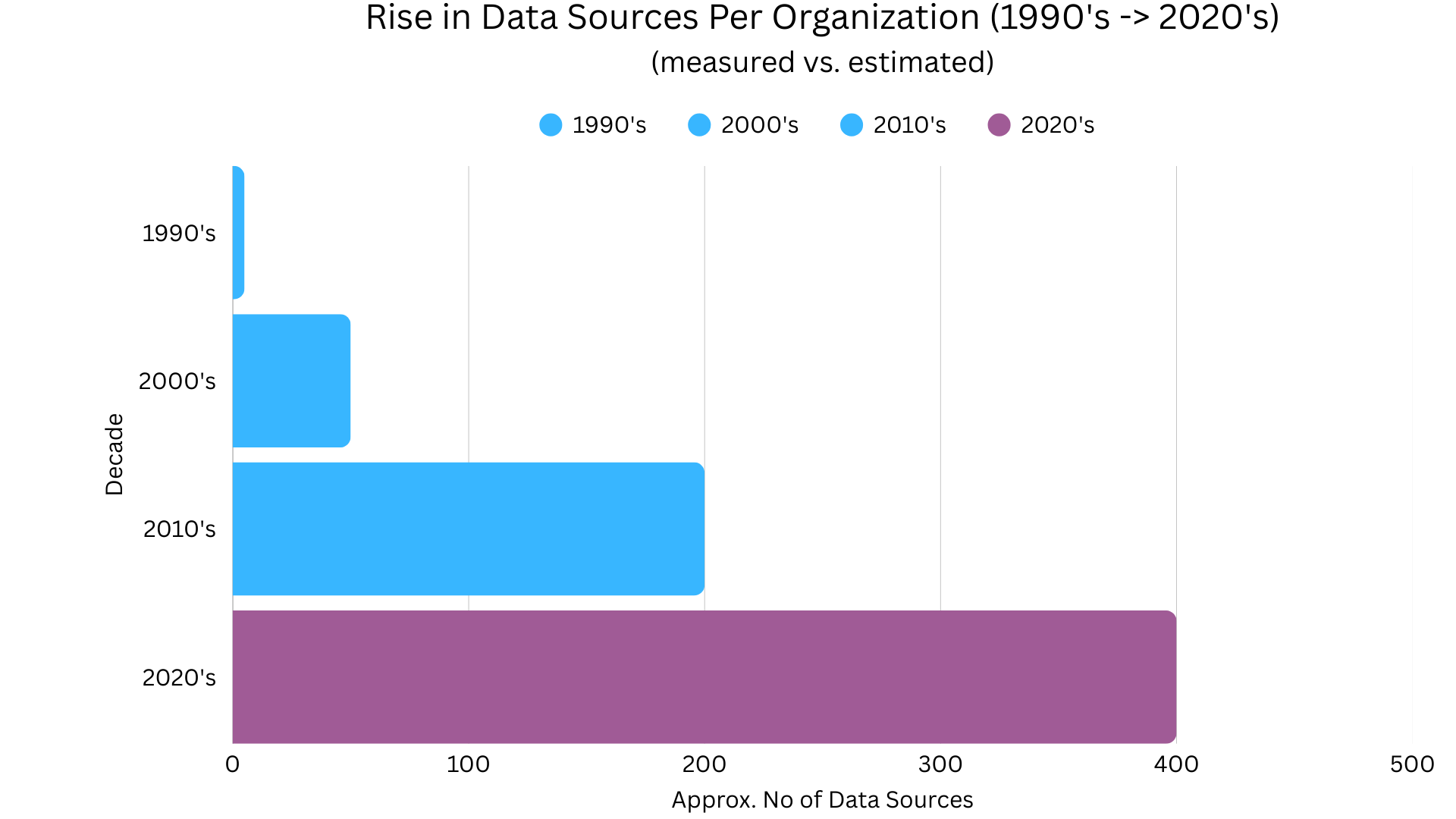
Note: 1990s–2010s values are illustrative estimates.
Source: Matillion and IDG Survey, Jan 2022; State of SaaS report, 2022;
Use of External and Internal Data, BARC, Jan 2017; ERP History, Oracle Netsuite, Aug 2022.
This often leads to teams doing the same work twice and missing out on key insights because they don’t have a single, reliable source of truth. Multiple modes of data sources mean multiple subscriptions to tools, which means more money needs to be flushed into this process, straining budgets.
Compliance is a Minefield
Data privacy and security regulations are getting stricter. Without a clear governance plan, you risk non-compliance, which can bring your data efforts to a screeching halt.
Trust and accessibility issues
Even when data is collected, employees often don’t trust it enough to act on it. And when they do, access is usually limited to a few technical teams, leaving decision-makers in the dark.
The Solution: A Modern Data Platform
Built on the Lakehouse architecture, Databricks combines the reliability of a data warehouse with the flexibility of a data lake. Instead of keeping different types of data in separate silos, the Lakehouse model enables you to manage everything—from simple spreadsheets to complex video and audio files—in a single, unified environment. This solves the biggest challenge companies face: disconnected data.
By creating a single source of truth, Databricks helps you manage all your workloads efficiently, whether you’re building a simple BI dashboard or an advanced AI model. It automates complex processes, ensuring you get real-time, high-quality insights for better decision-making. With built-in AI and machine learning tools, it’s easier for teams across your organization to build and scale models without needing a specialized technical staff. With enterprise-grade security and governance, you can grant more people access without compromising control or compliance.
In short, Databricks doesn’t just centralize your data; it makes it accessible, empowering decision makers in your company to explore, analyze, and act on insights with confidence.
At Innovature, our team of experts can help organizations with strategizing and migrating to designing custom dashboards and deploying advanced AI models on the Databricks platform. By leveraging Databricks as the core and integrating other necessary technologies, we build a seamless, end-to-end data ecosystem that unlocks maximum value for your business.
What does this mean for Your Business?
- Faster decisions: Your teams can now act on insights in real time, making your business more agile and responsive. This means less time spent on reviewing decisions and more time on strategic moves, which can benefit your business.
- Revenue growth: By optimizing pricing and finding better ways to cross-sell and upsell, you can directly boost your bottom line.
- Lower costs: Consolidating your tools and reducing platform fragmentation saves money on overhead and subscriptions. Earlier, it was 10s of tools each for cleaning data, visualization, data engineering, etc, now it is one platform for all your data needs.
- Empowered teams: Non-technical employees gain the ability to make data-driven decisions, which sparks innovation across the organization.
- Future-ready: With trustworthy and transparent AI, your business can easily scale to handle all types of data and new, AI-driven business models.
Conclusion
Remember, democratization must always go hand in hand with trust.
Innovature transforms data and AI into a strategic advantage for enterprises. If your goal is to unlock higher ROI, reduce inefficiencies, and scale data-driven decision-making, we can help you achieve it with our Databricks implementation services. To know more, reach out to our data experts.